Waymarking at the FLCC Arboretum

On the beautiful morning of Saturday, August 18, 2012 the Canandaigua Botanical Society gathered to learn about Waymarking and tree identification at the Finger Lakes Community College Arboretum.

Members attending: Bill Bross, John Hyde, Peggy Kane, Leona Lauster, Jeffery and Laura Ouimette

Under the Arboretum sign Laura gave this brief history of GPS Waymarking:  On May 2, 2000 President Bush announced that the United States would stop the intentional degradation feature (Selective Availability) of the Global Positioning System (GPS) signals. This action enabled civilian users of GPS units to be able to pinpoint locations up to ten times more accurately than in the past. GPS is a dual-use, satellite-based system that provides accurate location and timing data to users worldwide.  On May 3, 2000 a computer consultant named Dave Ulmer wanted to test the accuracy by hiding a navigational target in the woods. He called the idea the "Great American GPS Stash Hunt" and posted it in an internet GPS users' group. The idea was simple: Hide a container out in the woods and note the coordinates with a GPS unit.  Geocaching was born as well as Waymarking which uses GPS without the cache.  You can go to waymarking.com for listings of locations including our FLCC Arboretum under the category of arboretums!

Jeffery had preprogrammed the GPS units that we borrowed from Wood Library with several GPS coordinates made into a route for the group to follow.  Armed with GPS units we stopped at the programmed locations to be sure Laura had accurately identified the trees.  We also spoke about several other trees between each recorded GPS location.

GPS location                                        Description

N 42’ 52.248` W 077’ 14.604`           Arboretum sign

N 42’ 52.237` W 077’ 14.610`           Betulapapyrifera, Paper Birch, also known as American White Birch. Bill Bross teased that the college students maintain the white bark by paining it on a regular basis. 

Yet to be marked                                 walking from the Paper Birch tree to the next Waymark we identified the Beech and Large Leafed Magnolia (which Laura mistakenly thought might be a Pawpaw tree with its large leaves and fruit looking buds).

N 42’ 52.240` W 077’ 14.630`           Cedar near gazebo – at first John Hyde thought it looked like a juniper, but by it’s soft touch he agreed it is a Western Red Cedar, Thuja plicata, a cypress of the Pacific northwest.

N 42’ 52.263` W 077’ 14.649`           This Waymark we called the Square of pines and noted several trees including a Japanese Yew, Juniper (sharp to the touch), Austrian pine and Norway Spruce
 

N 42’ 52.248` W 077’ 14.660`           Laura was intrigued by this flat soft needled pine tree which she thought was a bald Cyprus.  John Hyde identified it as a Metasequoia glyptostroboides this short variety of deciduous redwood comes from China.

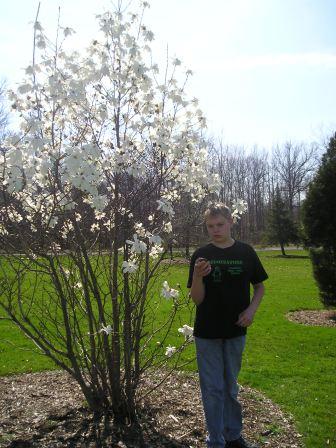
N 42’ 52.225` W 077’ 14.643`           This was one of the first trees we Waymarked in March 2012 when it was in full bloom with large white blossoms – a saucer magnolia or cucumber tree.

Before reaching our next Waymark we admired this small Japanese Umbrella Pine (Sciadopitys verticillata)

and John told us about the sick Lombardy poplar to the left of our next Waymark…

N 42’ 52.227` W077’ 14.669`            Weeping Norway Spruce (Picea abies ‘Pendula’)

N 42’ 52.215` W 077’ 14.671`           Not a tree…but to be sure you’re Waymark is accurate: Struggle rock sculpture by Robert Fladd 1985

N 42’ 52.259`  W 077’ 14.685`           We didn’t actually locate this Waymark…but it was marked in June when it looked like this:  probably a Blue Ash - Fraxinus quadrangulata or perhaps Tree of Heaven - Ailanthus?
From here we passed the new labyrinth and headed into the woods/marsh area to the south of the arboretum. Heading to our next Waymark John shared a wealth of information regarding the poplar / aspen / cottonwood tree as we passed several of them.  Peggy noted that they root out by runners and we found evidence of that here.

N 42’ 52.181` W 077’ 14.181`           Corkscrew willow (Salix matsudana) Many of us remembered this tree from our 2009 outing with Bruce Gilman. 
and into the woods...

N 42’ 52.122` W 077’ 14.731`           This Waymark brings you to a spot on the trail to notice a nearby oak tree with a split trunk and one of many Shagbark Hickory trees in the woods. 

N 42’ 52.081` W 077’ 14.739`           This Waymark brings you to the north end of the boardwalk.  We were curious to know what was growing where there is usually water.

N 42’ 52.067` W 077’ 14.751`           Once at this Waymark look up to find a birdhouse in a large Oak tree.

N 42’ 52.063` W 077’ 14.697`           Twin White Oak (look up beyond the maple leaves).  This is a photo from June when we had help from twins to record our Waymarks.

From here we backtracked and headed north along the wide wood-chipped trail to the next Waymark.  Jeffery posed for this photo between an Ash and an Oak tree – allowing a nice comparison for the bark differences Bill was learning about from John.

We also learned about the Lindera benzoin (Spicebush)appreciating the wealth of knowledge John had to share. 

There are several other tree species in the woods just south of the arboretum including black walnuts.

John was a true horticulture professor armed with his very own Michael Dirr encyclopedia of trees.

N 42’ 52.148` W 077’ 14.626`           This Waymark brings you to the bridge adjacent to Marvin Sands Drive. 

John asked about the paper Bark Maple that Bruce told us about back in 2009.  We were pleased to find it still located where it was…but much closer now to the newly structured roadway.

N 42’ 52.097` W 077’ 14.610`           Paper Bark Maple (Acer griseum) with cinnamon colored bark

Our plan is to continue Waymarking several more trees in the Arboretum.  If you’re interested in obtaining updated lists – or you have Waymarked coordinates to add to our current list, please let us know at CanandaiguaBotanical@gmail.com.  GPS units can be borrowed from Wood Library in Canandaigua. 
*some species still to be Waymarked at the FLCC Arboretum: Little Leaf Linden / Basswood, White Mulberry, Norway Maple, Red Maple, London Planetree, Sugar Maple, Pin Oak, Black Oak, Coranga Hedge, Native White Cedar, Thuja, Red Beech, Purple Beech, Hackberry tree, Tulip tree, Ginko, Scarlet Pimpernel, Colorodo Blue Spruce, European Larch tree.

Find the FLCC Arboretum listed at Waymarking.com:
http://www.waymarking.com/waymarks/WMF2QK_Finger_Lakes_Community_College_Arboretum


Pairing Technology and Nature - Waymarking at the FLCC Arboretum


Saturday, August 18, 2012    Time: 10 am

Where: Finger Lakes Community College Arboretum on Marvin Sands Drive off Lakeshore Drive south of Routes 5&20. Meet at the parking lot across from the Arboretum.

Armed with a GPS for Geocaching and a curiosity about tree varieties, Laura and Jeffery Ouimette have discovered “Waymarking” as a means of identifying the locations of several trees at the FLCC Arboretum. Please join us as we enjoy a leisure walk in and around the FLCC Arboretum to identify specific trees using hand held GPS units. (We plan to have several GPS units on loan from Wood Library). Please bring along your tree and wildflower guides.

In Geocaching, it’s all about the hunt and the treasure at the end. With Waymarking, the location itself is the treasure. The primary difference is that no physical object is placed when creating a Waymark. The focus is on what can be gained from the location itself.

Waymarking.com provides tools for you to catalog, mark, and visit interesting and useful locations around the world.

HUMINGBIRDS and BUTTERFLIES

On Saturdays, July 21 and 28 at 10 am the Canandaigua Botanical Society will be meeting at the Hansen Nature Center in Tinker Nature Park on Calkins Road in Henrietta.  Please join us and bring a friend or two!

On July 21st Diane Henderson, past Director of the Rochester Birding Association, will present a seminar on hummingbirds with optional hiking along nature trails.  Bring your lunch and sit on picnic benches or inside the Hansen Nature Center.

On July 28th Lucretia Grosshans, past President of the Rochester Butterfly Club and Rochester Birding Association, will tell us about butterflies in our area, why we need more of them, and how to attract them to your yard. Feel free to again enjoy the hiking trails and bring your lunch.

https://sites.google.com/site/hansennaturecenter/
** Please call the Tinker Homestead at 359-7044 if you plan to attend this free event! **

Please meet at 9:25 if you wish to carpool from the Ontario County Courthouse parking lot

Laura will be delivering mail both days and would GREATLY APPRECIATE anyone who might share notes and photos to post here on the website.  THANKS!


ODONATA SANCTUARY PHOTOS


THANKS TO LEONA FOR THESE PHOTOS FROM THE ODONATA SANCTUARY TOUR!
 Ginko tree


fan-shaped leaves of the Ginko tree

Peggy and Bil in front of large black willow
Black Willow branch
Black Willow tree
easier to identify when gone to seed this Virgin's Bower
Solomon's Seal past flowering
Bloodroot
Bill Bross was our guide
Narrow-leaved Cattails: the upper and lower parts of the spike are usually separated by a distinct gap
Nymphaea orderata is called Fragrant Water-lily (Peterson's Guide) and Sweet-scented Water-lily (Newcomb's)
Mailbox for Fishing Derby results
Don't go looking for translucent frogs! (Visitors are told to canoe out into the pond to see translucent frogs and then the fountain was turned on.  Guests got soaked and everyone laughs.)
Bedstraw and Evening Primrose
Fleabane
Sycamore tree
beautiful bark of the Sycamore tree
Taylor Pond - very deep
Ox-eye Daisy
Peacock
Goats
sheep
pig
Donkey

SENECA BREEZE BERRIES NOW OPEN!


SENECA BREEZE BERRIES will be opening for the season on Saturday, June 9th, 10-5.  
The strawberries aren't quite ready yet......should be ready about June 22nd.

Lettuce, spinach, arugula and many herbs are ready!!  They are available U-Pick or We-Pick. 

Fresh homemade jams, local honey and maple syrup are available in our store along with a new product - Apple Strawberry Dog Treats!!

Hawaiian Shave Ice will taste really good on a hot day! 

We are now the NY State Distirbutor for HydroStacker - come see our product displays.  You too, could grow your own hydroponic fruits and vegetables!!!  Just think no kneeling or bending!!

June 
Friday & Saturday  10-5
July-August
Thursday   2-5
Friday, Saturday & Monday  10-5
Sept-Oct
Friday & Saturday 10-5

Also, you'll find us at the following Farmers' Markets
VA Canandaigua - Tuesday  1:30-5:00
Dundee - Wednesday  3:30-6:30
Geneva - Thursday     7:30-1:00 

See you soon!
 Paul & Kathryn Cooley

Interested in receiving Botanical updates via Email?

I am finding that the press releases that I send out to local newspapers and online calendars are often "ignored" and postings of our Canandaigua Botanical Society events do not appear in print or online.  I generally send out Email reminders about our events to anyone who has shared their address with us at canandaiguabotanical@gmail.com.  You are welcome (and encouraged) to pass the Emails on to friends as we are more than happy to have many people come to enjoy the botanical events planned throughout the year.  If you don't already receive Email updates about upcoming events...and would like to...please just send us a message with your preferred Email address and we'll be sure to include you in on future updates!
Any members who prefer to be reminded by phone and are not already on our calling list may also be added to our phone lists to receive a friendly call a week in advance of botanical events.
THANKS! ~ Laura Ouimette, canandaiguabotanical@gmail.com

A GUIDED TOUR OF ODONATA SANCTUARY


Saturday, June 9, 2012

Time: 10 am to noon or car pool from the Ontario County Courthouse parking lot at 9:30 am.

Where: Tucked away at the corner of Landing and Parrish Roads in Honeoye Falls.  From Canandaigua, go west on Rts. 5 & 20 through Bloomfield. Turn right on Route 64 for 3.3. miles. Turn left on CR 14 for 2.7 miles. Go right on W. Bloomfield 1.3 miles and right onto Parrish Rd. to Lanning Road intersection. (GPS: 20 Parrish Rd., Honeoye Falls, NY)

Odonata Sanctuary is the former estate of Joseph W. Taylor who was Treasurer of Bausch & Lomb and a world-class bird watcher. A few years ago, the Melcher family purchaseD the property from the children of Joseph Taylor to both preserve and enhance the beauty and provide a home for their family of six.
We will explore the grounds, which includes meadows and a large pond (Taylor Pond). For the more adventurous there are also acres of well-trailed wooded property. Odonata is now the home of a Bluebird restoration area and is a member of United Plant Savers.

Leaders: Bill Bross and/or Steve Melcher.

Notes from the MULLER FIELD STATION walk

Thanks to Caroline Gray for sharing these notes.

Attending: Caroline and Robert Gray with Philo and Charles, John Hyde, Sharon Horton and Marty Dodge as our guide.  And what a guide!


Marty Dodge started right in with the willows by the parking lot and told us many interesting and useful plant facts. 
Willow bark contains aspirin but is quite acidic.
Buttercups are poisonous. 
Plantains are edible with the narrow leaf plantain being better eating.
Some say milkweed is toxic, but the young pods are tasty when fried.
Dog Bane bark makes good twine.

We compared several different grasses; most of which were in bloom --achoo! 
We identified poison ivy and tried to impress its recognition on the boys.

Professor Dodge talked about invasive plant species such as the rose bushes and tartarian honeysuckle.  He also talked about the various invasive beetles that are threatening the Northeast.  Perhaps best of all, Professor Dodge taught Charlie how to make noises by blowing on a blade of grass!

For more information about the Muller Field Station...  http://www.flcc.edu/muller/index.cfm

A WALK AT MULLER FIELD STATION


Saturday, May 26, 2012  
Time: 10 am to noon or car pool from the Ontario County Courthouse parking lot (entrance on Sly Street and Ontario Street) at 9:15 am.
Where: The Field Station is located approximately 1 mile south of Honeoye Lake on West Lake Road (County Road #36).
This expedition upon the grounds of the FLCC Muller Field Station will include but not be limited to a visual exploration of silver maple/green ash forest from a dry land vantage point, consideration of the ecology and utility of a number of species of forest trees as well as consideration of properties and possible uses of herbaceous plants. We will look for signs of successful reintroduction of the river otter and of black bear activity. The terrain includes primarily level paths of mowed grass and fine gravel driveways. Leader: Marty Dodge  For more information you may contact Bruce Gilman or canandaiguabotanical@gmail.com
This photo was taken at our last visit to Muller Field Station in 2008.

***Please consider bringing a camera if you are able to attend.  Since I now work on Saturdays I'll need to depend on other botanical members for notes and photos***

In Canandaigua, a tree of remembrance


Printed in the Daily Messenger newspaper -  Sunday, April 29, 2012

 Scott Pukos | Messenger Post Media         Canandaigua, N.Y. —
The chilly temperature couldn’t stop an Arbor Day celebration in Canandaigua Friday afternoon.
To celebrate the nature-related holiday, the city’s parks and recreation department planted an English Oak tree at Sonnenberg Park. The tree was planted in memory of Maya Hobday, who lived near the park, on Charlotte Street, for more than 50 years.
Hobday’s family said the cold spring weather wouldn’t have bothered her.
“She used to always say, ‘there’s no such thing as bad weather,’” said Hobday’s daughter Silvia Moore. “‘Just bad clothing.’”
Moore added that her mother was an avid naturalist, who would always walk her dog in the park or meet up with neighbors in the area. Hobday was also a member of the Canandaigua Botanical Society and Ontario Pathways.
Parks and recreation staff — including Park Maintenance Supervisor and certified arborist Chris Dorn — demonstrated the proper way to plant and care for a tree during the celebration. After the demonstration, Mayor Ellen Polimeni read an Arbor Day declaration.


Maya Hobday was an avid naturalist, a member of the Canandaigua Botanical Society and Ontario Pathways.               


City of Canandaigua parks and recreation workers plant a tree Friday at Sonnenberg Park in Maya Hobday's memory.


Family members of Maya Hobday smile at Sonnenberg Park after the longtime resident was honored during the city’s Arbor Day celebration. From left are Hilda Mannato, Peter Hobday, Silvia Moore, John Moore, Josiah Moore and Ruthie Romero. 


TALES FROM THE VINEYARD


Presentation by Paul E Brock II – FLCC Viticulture professor and owner of Silver Thread Vineyard http://silverthreadwine.com/

Paul Brock has always enjoyed wine making and is fairly new to grape growing as the new owner of Silver Thread Vineyard.  We were especially grateful that he brought three bottles of wine to enjoy!
(Good Earth White, Gewurztraminer, Dry Riesling) Paul explained the turtle on the label as it related to a stone carving found on site in the Bronx Botanical Gardens.  The turtle image was carved in a rock beside one of New York’s woodland creeks by a Native American artist many centuries ago. As an earth symbol to the Iroquois people, the turtle reminds us to care for the land and water that give us the gift of wine.

Paul told us about the Technology Farm http://www.thetechnologyfarm.com/  near Geneva.  The FLCC Viticulture and Wine Technology center at the Cornell Agricultural Technology Farm is planned for a 2013 opening.

Paul spoke about
vitis riparia – a native species, hardy to cold;
and       vitis aestivalis – local distribution especially along Rt 89 towards Ithaca and at Ganondagan

1829: Reverand William Bostwick planted the first vineyard in the Finger Lakes in his garden rectory in Hammondsport (Saint James)

1848: Edward McKay plants the first vineyard along Canandaigua Lake

Paul showed photos of Widmar wine tanks in Naples…likely to be turned into a museum.

Similar to apple trees – grafting is done to manage specific grape varieties on strong rootstock. 
Grape vines will live forever.  Younger vines produce more grapes while older vines produce better wine (vines know the soil).

Paul told us about the New York State’s AVA  (American Viticulture Areas)
            Long Island, Hudson Region, Finger Lakes Region, Lake Erie, and Niagara Escarpment,
AVA is listed on a wine label to identify where that wine came from (at least 85%)
 
Weather has a great influence on grape growing and the lakes with their individual lake effects play a major role.  Hardier grapes do well nearer the lake while sensitive wines come from areas outside of lake effects.  The Finger Lakes AVA has glacial soil.  Soil characteristics can very widely.  As an example there can be 8-10” of soil in one area and 18” just 100 yards away.

Riesling is especially forgiving if you can get it to grow.  Chardonnay is an extremely forgiving variety.

Canada uses windmills due to rather flat growing areas for their grape vines.

Paul talked about how the weather has affected viticulture in the Finger Lakes.
            The spring of 2011 was really wet, followed by a dry summer and then a really wet fall. 
Weather affects the taste of grapes at harvest. 
Factors of location and soil are major contributors.
Leaves orientation to the sun affect photosynthesis, sugaring, and stop/change metabolism.
Grapes have a 1 year reproductive cycle and a 2 year development cycle
2012 has been a year of Water versus Sunlight
            Lodi saw LOTS of rain
            Growing degree days > heat accumulation
            2011 was warmer than normal meaning more fungus
            Warm and wet > fungus
            Paul told us about his Riesling fat white grapes split with juice.
            Vitritus or noble rot      
Because Silver Thread is organically managed they saw only 5-6% rot while traditional spray programs saw 50-60% rot.

Paul showed us tables with critical temperatures for grapes indicating kill percentage for cold temperatures affecting various growth stages.  Generally, bud break is not seen until May 1st.  This year bud break occurred on March 22nd.  The grape growing season is here…time will tell whether it will be the longest or shortest growing season on record.

Paul invites us to please visit the Silver Thread tasting Room along the eastern shore of Seneca Lake http://silverthreadwine.com/  and also encourages us to meet his wife, Shannon, who is a wine instructor at the New York Wine & Culinary Center http://nywcc.com/

ANNUAL MEETING MINUTES - APRIL 20, 2012

Attending: Paul Brock, Judi Cermak, Margo and Bruce Gilman, Peggy and Peter Kane, Leona Lauster, Lauralee and John Maas, Hilda Mannato, Sylvia Moore, Laura Ouimette, Dave Poteet, John and Mary Purdy, Elizabeth Schwarzweller, Elisabeth Socci,

Treasury report:
                        April 2011 ……………….$ 758.27
                        Dues received ……………$ 206.00
                        Expenses ………………...$ 250.00  
                        Received Maya Memorial..$400.00

                        Current balance………….$1112.36

Secretary report:
            Minutes from this past year are in the 2011-2012 yearbook as well as available online. The 2012 – 2013 Botanical Program of events is listed at the bottom of the website. 
            Due to a new job with the Post Office, Laura Ouimette will be unable to attend many of the Saturday events.  Please think about bringing a camera and sharing notes and pictures with Laura in order to be able to continue posting notes on the website.
            One of our members, Leigh Jones gave Maya Hobday a copy of the book she authored with her brother Stephen B. Agard, It Happened at Hopewell: Jacob Isenhour’s Cobblestone Legacy.  We will donate the book, signed by Leigh, to the Gorham library (Wood Library already has a copy).
            There was a discussion about ideas for the $400 that was donated to the Canandaigua Botanical Society in honor of Maya Hobday who passed away on September 12, 2011.  An English Oak tree will be planted at Sonnenberg Park in honor of Maya by the City of Canandaigua during their 20th anniversary Arbor Day celebration on April 27th.  A plaque could be purchased to accompany that tree.  A white cedar tree was planted in remembrance of Sam Hobday (Maya’s husband) in the FLCC Arboretum.  Perhaps a plaque dedicated to both Sam and Maya could be placed in the arboretum.  Maya loved all trees and plants.  A white paper birch was mentioned as one of her favorites.  Maya especially appreciated a butterfly bush and the butterflies it attracted outside a window at Elm Manor during the summer of 2011.  The idea of a simple bench along a favorite nature trail would be another idea.  We agreed to table the decision on how to spend the $400 until further discussion and consultation with Maya’s four children was considered.  

Maya’s daughter, Sylvia Moore, set out a table display of Maya Hobday’s Botanical items.  Peggy Kane read the “formal” role call of past members which were familiar to many.  Laura brought a metal specimen box that belonged to Maya.  Bruce Gilman informed us that its proper name is a VASCULUM and that it is the perfect length for botanical specimen paper.  Peggy Kane suggested that we think about a means to preserve much of our Canandaigua Botanical Society history.  

Peggy let us know about additional events available to us after the printing of our programs.
PLEASE LET PEGGY KANE KNOW IF YOU ARE  INTERESTED IN GOING!!!
            Saturday, May 12, 2012  at 10 am – Lilac Festival, Ellwanger Park – open to the public but we can have our own horticulturist .  
Saturday, June 2, 2012 at 10 am – Tour of Ellwanger Garden for peonies with our own horticulturist.  (and the Stone Tolland House for $5.00 a person)

ANNUAL POTLUCK DINNER AND PRESENTATION

FRIDAY, APRIL 20, 2012
THE MANY FACES OF VITICULTURE AND COMMON VINE "TALES" THAT SHOULD BE UNCOMMON

Our annual meeting begins at 6:00 pm at Saint John’s Church, 183 North Main Street, Canandaigua. We will meet downstairs in the parish hall; use the rear entrance on Saint John’s Court, off of Howell Street (Gleaner’s Kitchen).

Bring a dish to pass and your own place settings, a guest or two if you wish. Bring cash or a checkbook to pay your annual dues ($7 single; $10 family) and receive the 2012-2013 Canandaigua Botanical Society program.

Our presentation will begin after dinner at 7:00 pm. Following the program we will have a business meeting and all are welcome.

Speaker: Paul Brock, Viticulture and Wine Technology Instructor, Finger Lakes Community College.

HORTICULTURAL THERAPY


Minutes from our March 24, 2012 Horticulture Therapy Presentation
Attending: Bill Bross, Jill Byington, Peggy Kane, Carman Kuenen, Jana Lamboy, Leona Lauster, Laura & Jeffery Ouimette, Mary & John Purdy, Liz & Harry Schwarzw, Rochelle Smith
Presenting: Beverly J. Brown Ph.D., HTR
Associate Professor at Nazareth College – Biology Department
Director, Horticulture Therapy Program Bbrown6@Naz.edu
Beverly Brown talked with us about Horticulture Therapy: Putting the healing power of plants to work.
Many of us agree that working out in the garden with trees and plants helps us “feel better” whether we are doing it on our own or with others.
Horticulture Therapy involves several components:
plant
therapist
client/resident/member
set of specific therapeutic goals
Horticulture Therapy can be used in multiple settings and can address diverse therapeutic goals involving physical and occupational therapy, thought, and new vocational skills.
Therapeutic Goals might include: improved range of motion, increased stamina, reduced anxiety, increased sense of well-being, development of social skills, and development of job skills.
Diverse Client Populations:
Elderly
Veterans
Intergenerational groups
Addictions
Disabilities
Recovery
Incarcerated
Plants are added to speed up improvements.
What’s the biology behind this?
Remembering stuff – never the same twice - recoded with atmosphere
Unusual skill set: INTERWOVEN
Botanical knowledge
Horticulture knowledge
Landscape design
Psychology
Therapeutic skills
Program management
Communications/facilitating
Horticulture Therapy Registered (HTR) requirements
Bachelor of Arts or Science
12 semester credit hours in horticulture
12 semester hours in psychology
9 semester hours in horticulture therapy
480 hours supervised internship (within 2 years)
The Future of Horticulture Therapy
As the population ages > greater need for therapies of all kinds
American Horticulture Therapy Association will establish licensing
AHTA is working toward making HT a reimbursable activity as medical treatment
(recreation therapy/social work)
Future at Nazareth College
HT fits well with established programs in other therapies
Minor in HT
Establish a major in HT
Establishment of a certificate program in HT
Eventually available as an online program (with short time actually at Nazareth)
Currently split science and therapy
Construction at Nazareth includes plans for horticultural therapy garden and green house with the new math and science building
Plans include walkways, raised beds, specifics like tinted concrete, greenhouse with 3 bios, all spaces handicapped accessible with HT actions in mind, easy access between presentation spaces and greenhouse. Designed to distress and relax, variety of gardens surrounding the greenhouse for many uses including HT.
Examples of Horticulture Therapies
Nazareth College Aphasia Clinic
Survivors of strokes
Word recall
Task sequencing: “How to pot a plant”
Social interaction
Sojourner House
Shelter for women in transition
Making wreaths – creative, learning to persevere
Seeking Common Ground’s HERB HAVEN (Deborah Denome, President/Director)
Herb Haven is a program for women and children in transition from prison, drug abuse, and domestic violence.  The recidivism rate for Herb Haven is 25%. That means 75% of the women who go through the program go onto college or jobs and are out of social services systems. It costs $3000 for a woman to go through the program.

Herb Haven is Horticultural Therapy workshops to at-risk women and children in different situations.
Herb Haven is located at 4487 East Lake, Road in the hamlet of Crystal Beach, 4 miles south of Canandaigua, New York.Volunteers are always welcome!

IN THE WORKS....

Beverly Brown shared a wonderful presentation about Horticulture Therapy this morning. I am hoping to have minutes posted here within the next few days.

Peggy, Laura, and Bill met today to work on the Canandaigua Botanical Society Program for 2012-2013.

Please plan to join us on Friday evening, April 20th for our annual potluck dinner and presentation when we will hand out the new programs.

On Friday, April 27th the City of Canandaigua will be planting a tree in memory of Maya Hobday at Sonnenberg Park for Arbor Day.

Due to the summer like weather this spring, we are anticipating that the bluebells will all be gone by our usual annual Bluebell Walk in early May. PLEASE send an Email to us at canandaiguabotanical@gmail.com
if you have any public places you think others might be interested in seeing "early" spring blooms. I can notify others by posting locations here on the WeBlog and/or I can send Email messages to Botanical members. There are several new Botanical members from outside the area - so even locations which are well known would be appreciated.


Can you identify these flowers under Maya's Magnolia tree?
????? and bloodroot

Learn about HORTICULTURE THERAPY

Canandaigua Botanical Society’s Indoor Meeting at FLCC room C-220

Saturday, March 24, 2012 10 am

Come learn about Horticulture Therapy (HT), the practice of using horticulture as therapy to improve human well-being. Horticulture therapy is not only a rapidly emerging profession; the therapeutic benefits of peaceful garden environments have been understood since ancient times. Today HT is recognized as a practical and viable treatment with wide ranging benefits for people in therapeutic, vocational, and wellness programs.

Presenter Beverly Brown is a registered Horticultural Therapist with her own practice. She is an Associate Professor at Nazareth College and has developed a newly offered Horticulture Therapy minor there. Beverly will also talk about Herb Haven.

Finding FLCC, Room C220

The FLCC Canandaigua Campus is located on the northeast side of Canandaigua Lake.


The Canandaigua Botanical Society generally holds indoor meetings at Finger Lakes Community College - Room C 220. During this time of construction on the FLCC campus it has been difficult to get to Room C 220 (even those who know where it is located) .

Room C 220 is located in building 8 on the map above. It is easiest to get to Room C220 by entering from loading dock entrance C on the map. You can park in the southeast corner of lot A and walk up Laker Lane to get to the building. If construction allows, parking may also be available closer to the building in loading dock C.

How to find C 220 as of March 14th:

** Turn onto Marvin Sands Drive and take the second left onto Laker Lane.

** Follow Laker Lane around to the first stop sign. (Take a right at the stop sign into the parking lot and proceed by foot…)

** Continue along Laker Lane to the second Emergency blue light east of building C (look for Canandaigua Botanical Society sign).

** The entrance to building C is on the left closest to Laker Lane.

** Room C 220 will be inside, straight ahead, and to the left.


HERBARIUM WORKSHOP

Wednesday, February 15, 1 pm - 4 pm – Life Sciences section will hold a workshop at the RAS Herbarium, located in the basement of the Rochester Museum and Science Center (RMSC). No experience needed! Plan to come and help with this valuable collection – and see some interesting plants! Lunch is served in the RMSC Cafe until 2 pm. If you plan to attend, please send an RSVP to Elizabeth Pixley. Then, at RMSC, go to the front desk and ask staff person there to call ext. 368, the phone in the Herbarium. For more information, contact Elizabeth Pixley, herbarium curator (334-0977 or epixley@rochester.rr.com).

CALL FOR PROGRAM IDEAS!

We will soon be putting together the 2012-2013 Canandaigua Botanical Society Program. Your ideas and interests are requested. Is there a program you are interested in, something you would like to know more about, a repeat of a past favorite botanical event? Do you know of possible presenters or field trip leaders? Let us know! Peggy Kane and Laura Ouimette (and anyone else interested in helping put together program ideas) will be working these next couple of months to have a printed program guide ready for the April 20th potluck dinner. You can contact Laura or Peggy by phone (check the 2011-2012 program for our phone numbers) or Email CanandaiguaBotanical@gmail.com.

***Please consider family friendly programs too***

HERBARIUM WORKSHOP - Saturday, January 14, 2012

Saturday, January 14, 10 am – 2 pm - Life Sciences section will hold a workshop at the RAS Herbarium, located in the basement of the Rochester Museum and Science Center (RMSC). No experience needed! Plan to come and help with this valuable collection – and learn about plants in the process. Lunch is served in the RMSC Cafe until 2 pm. If you plan to attend the workshop, please send an RSVP to Elizabeth Pixley. Then, at RMSC, go to the front desk and ask staff person there to call ext. 368, the phone in the Herbarium. For more information, contact Elizabeth Pixley, herbarium curator (334-0977 or epixley@rochester.rr.com).