


Dr. Bruce Gilman will be presenting a Winter Education Class about NY Wildflowers and Native Plants at Sonnenberg Gardens on Saturday, February 23, 2013: http://www.sonnenberg.org/client_images/catalog19990/pages/files/NewYorkWildflowersNativePlants.pdf
VISIT TO NAZARETH COLLEGE’S NEW GREENHOUSE AND HEALING GARDENS
Saturday, March 16, 2012
Time: 10 am to noon (or meet at the Ontario
County Courthouse to carpool at 9:20 am)
Where: Nazareth College, 4245
East Avenue meet at 101 Peckham Hall (26 on map) http://www.naz.edu/campus-map
Directions: Take 90 west to exit 45.
Follow Rt. 490 north to Route 31 west. Follow Rt. 31 one and half miles to village of Pittsford. Turn right at the village’s 4
corners onto Rt. 96 N. Nazareth is a half-mile down on your left. (Park where you can find a space. On the weekend,
behind Shultz Hall might be available - Lots D,E,F on map. There are visitor parking spaces there.
Otherwise, just park wherever you find a spot.
www.naz.edu/campus-map)
Horticultural Therapy is the
practice of using horticulture as therapy to improve human well-being. HT is
not only a rapidly growing profession but also the benefits of peaceful garden
environments have been known since ancient times.
Nazareth College
has developed a minor in HT and has recently built a fabulous greenhouse and
healing garden paths.
Our presenter is Bev Brown,
Associate professor, Biology Department at Nazareth College
and she has developed HT courses. She is a registered HT with her own practice
and she mentors others who are seeking credentials in HT.
Rochester Permaculture Center course
Patty Love is offering Permaculture Design Certification courses. For more information go to:
http://rochesterpermacultureinstitute.org/events/pdc/
Take advantage of the $100 discount until February 7th.
http://rochesterpermacultureinstitute.org/events/pdc/
Take advantage of the $100 discount until February 7th.
Please help fund the Lagoon Park restoration project
Dear Members and Friends of the Canandaigua Botanical Society:
On September 10, 2012, four
members of the Canandaigua Botanical Society toured Canandaigua’s Lagoon Park
with Jim Engel. For those who may have
not visited Lagoon
Park, it is the 34 acre
wetlands directly across from Steamboat Landing on Lakeshore Drive in Canandaigua. Walking paths, bridges, fishing platforms,
and lookouts are all part of the Lagoon
Park. Unfortunately, as Engel pointed out, a
sizable portion of the park has been overtaken by invasive plant species,
particularly European Buckthorn.
Two years ago, Engel, the
owner of White Oak Nursery in Geneva, asked the City of Canandaigua for
permission to restore the natural beauty of the Park by removing the invasive
growth and planting flora and trees native to the Finger Lakes such as Spicebush,
Nannyberry, and Arrowood Viburnum to name a few. The City gave Engel permission to proceed on
the project, but no funding.
The work to restore the Park
will cost approximately seven to ten thousand dollars and will be completed by
the fall of 2013. Engel has already
begun removing the Buckthorn. In
September, the Canandaigua Botanical Society donated $300 toward the project. The Canandaigua Watershed Association is also
very much in favor of this project and at a recent meeting, agreed to match our
$300. More importantly, said they would
encourage more donations by individuals and organizations with a matching fund
of $3000. At our last CBS meeting at Finger Lakes Community College, those present voted
unanimously to send a letter to all members and friends of the CBS asking for
individual contributions.
Imagine the Lagoon Park
restored to its original beauty and welcoming presence, not just to all who
walk its paths, but to the native insects, birds, and wildlife that will be
attracted back to the park by this restoration.
You can help accomplish this
goal and take advantage of The Canandaigua Lake Watershed Association’s
generous matching offer by making a contribution today.
Checks should be made out to
the Canandaigua Lake Watershed Association.
Note on the check that the donation is for the Lagoon Park Project. All contributions are fully tax deductable. Send your contribution to Canandiagua
Lakefront Association at 493 South
Main Street, Canandaigua NY 14424.
If you have any questions,
you can call Peggy Kane (thirty nine 4 7616) or Bill Bross (sixty one 5 6255)
Take a walk around the Lagoon Park
and we think you will want to support the Lagoon Park
restoration!
Peggy Kane and Bill Bross
Co-Presidents of the
Canandaigua Botanical Society.


Canandaigua Botanical Society - Established 1874
Dedicated to advancing the knowledge and enjoyment of all plants growing in the Finger Lakes Region and Beyond.
Dedicated to advancing the knowledge and enjoyment of all plants growing in the Finger Lakes Region and Beyond.
Updates regarding the Lagoon Park Project
MINUTES OF THE NOVEMBER 10, 2012 MEETING
OF THE CANANDAIGUA
BOTANICAL SOCIETY
15 Members gathered at FLCC.
Jim Engel, a landscaper spoke to the Members about his
proposed project to restore the Lagoon
Park off of Lakeshore Drive. He
proposes to remove invasive plants (primarily Buckthorn) and allow native
plants to come back and thrive. Non-native plants do not support native
insects, birds, wildlife creating a sterile environment. He has met with the
City of Canandaigua
and they have approved his idea with the caveat that he begin with a “demo”
area to assess how well this project might be.
The Members voted to approve this project, agreed to donate
$300.00 to be matched by the FLWA, and to send a donation letter to all members
of the Botanical Society.The Finger Lakes Watershed Alliance has pledged to
match all donations up to $3000; other companies, individuals, and
organizations will also be solicited with Bill Bross helping to write the
ask.
Here are photos and updates shared with us by Jim Engel on December 16, 2012:


Hello all.
I spent this past Thursday and Friday treating the invasive at lagoon park. I will finish up a few remaining patches this coming Monday. If you get a chance stop by and take a look. The view shed has opened up considerably especially the view of the water.
Keep in mind that this is a work in progress. You can't make an omelet without breaking an egg. Remember it is necessary to kill all of the invasives to make room for the native plants that will replace them.
Next spring when the remaining native plants leaf out the new foliage will obscure much of the brush. The plan is also to replant with native trees and shrubs especially where there was only buckthorn. Also after about a year the majority of the small twigs and small branches will become brittle and break up, the brush will gradually compact, naturally decompose and over time disappear.
I took a series of pictures to show the changes taking place. The first image is of the trail will buckthorn still in leaf , the second one is of the trail before treatment and the third is after treatment.
I spent this past Thursday and Friday treating the invasive at lagoon park. I will finish up a few remaining patches this coming Monday. If you get a chance stop by and take a look. The view shed has opened up considerably especially the view of the water.
Keep in mind that this is a work in progress. You can't make an omelet without breaking an egg. Remember it is necessary to kill all of the invasives to make room for the native plants that will replace them.
Next spring when the remaining native plants leaf out the new foliage will obscure much of the brush. The plan is also to replant with native trees and shrubs especially where there was only buckthorn. Also after about a year the majority of the small twigs and small branches will become brittle and break up, the brush will gradually compact, naturally decompose and over time disappear.
I took a series of pictures to show the changes taking place. The first image is of the trail will buckthorn still in leaf , the second one is of the trail before treatment and the third is after treatment.
Jim
Kathleen Draper tells us about BIO CHAR
Our guest speaker On November 10, 2012 was Kathleen Draper who gave a fascinating
overview of the history and current research related to bio char. She recently
completed her Masters in Sustainability where her thesis focused on the
creation of a small scale, replicable bio char model.
Bio char is a carbon negative soil conditioner that boosts
plant growth while reducing the need for fertilizer and watering. Baking
organic waste turns lots of the CO2 absorbed during the plant’s life into a
stable form of carbon. When the char is planted in dirt, it ditches the carbon
cycle and snuggles up with plant roots; the result is lots of beneficial
micro-organisms, a safe place to roost, and it holds water.
This filtration medium and soil conditioner is what bio char
is all about. Over 2000 years ago, Native Americans in the Amazon were actively
improving the soils in rain forests. Pre-Columbians created what’s known as
terra preta, “black earth.”
Kathleen has launched Finger Lakes Bio Char and has been
working closely with several area vineyards to help them reduce phosphorous and
nitrogen leaching into ground water and Lakes.
Kathleen can be contacted at www.flbiochar.com
Respectfully submitted, Peggy Kane
SUSTAINABLE PRODUCTION AND USE OF BIOCHAR – Steps to save our planet
Learn about BIOCHAR
When: Saturday, November 10, 2012
Time: 10 am to noon
Where: Room C220 at FLCC (directions below)
Kathleen Draper will present an
overview of the history and current research related to biochar. Biochar, also
known as ‘terra preta’ is an ancient soil management technique, which safely
stores carbon for hundreds and possibly thousands of years. Biochar is produced
from local waste biomass such as fruit pits and wood chips.
Kathleen Draper recently
completed a Masters in Sustainability at Marlboro College where her thesis focused
on the creation of a small scale, replicable biochar model.
She has launched Finger Lakes
Biochar http:/fingerlakesbiochar.com which is producing biochar from local
waste biomass and is researching the potential of biochar’s use in vineyards as
well as whether it can help reduce phosphorous and nitrogen leaching into
ground water.
Finding FLCC, Room C220
The FLCC Canandaigua Campus is located on the northeast side of Canandaigua Lake.

The Canandaigua Botanical Society generally holds indoor meetings at Finger Lakes Community College - Room C 220.
Room C 220 is located in building 8 on the map above. It is easiest to get to Room C220 by entering from loading dock entrance C on the map. You can park in the southeast corner of lot A and walk up Laker Lane to get to the building. Parking may also be available closer to the building in loading dock C for those with handicap permits.
How to find C 220:

The Canandaigua Botanical Society generally holds indoor meetings at Finger Lakes Community College - Room C 220.
Room C 220 is located in building 8 on the map above. It is easiest to get to Room C220 by entering from loading dock entrance C on the map. You can park in the southeast corner of lot A and walk up Laker Lane to get to the building. Parking may also be available closer to the building in loading dock C for those with handicap permits.
How to find C 220:
** Turn onto Marvin Sands Drive and take the second left onto Laker Lane.
**
Follow Laker Lane around to the first stop sign. (Take a right at
the stop sign into the parking lot and proceed by foot…)
**
Continue along Laker Lane to the second Emergency blue light east of
building C
** The entrance to building C is on the left closest to Laker Lane.
** Room C 220 will be inside, straight ahead, and to the left.
SPICE OF LIFE
Thanks to Stephen Lewandowski for this:

SPICE OF LIFE
Strong odor rises
from our footsteps
as we tramp through
a small, wooded glen
set in farmland
but never worked.
What's that smell?
Pure strand of
soft-stemmed plant
holds out clusters
of white flowers and
heart-shaped leaves.
Alliaria officinalis
or garlic mustard
has been used by
generations of
ordinary folks.
Though the authorities put
a price on your head-
alien, invasive, exotic-
my ancestors who
had no other seasoning
used you as
"sauce-alone".

Rochester Academy of Science Herbarium Workshops
Saturday, October 20, 10
am - 2 pm – Life Sciences section will hold a workshop at the RAS Herbarium,
located in the basement of the Rochester Museum and Science Center (RMSC). No experience needed! Plan to come and help
with this valuable collection – and see some interesting plants! Lunch is served
in the RMSC Cafe until 2 pm, or you can bring your lunch. At RMSC, go to the
front desk and ask staff person there to call ext. 368, the phone in the
Herbarium. If you plan to attend, please send an RSVP to Elizabeth
Pixley, herbarium curator, 334-0977 or epixley@rochester.rr.com.
Wednesday, November 14, 1 pm - 4 pm – Life
Sciences section will hold a workshop at the RAS Herbarium, located in the
basement of the Rochester Museum and Science Center (RMSC). No experience needed! Plan to come and help
with this valuable collection – and see some interesting plants! (Lunch is
served in the RMSC Cafe until 2 pm) If you plan to attend, please send an
RSVP to Elizabeth Pixley. Then, at RMSC, go to the front desk and ask staff
person there to call ext. 368, the phone in the Herbarium. For more information,
contact Elizabeth Pixley, herbarium curator (334-0977 or epixley@rochester.rr.com).
From the Finger Lakes Community College newsletter:

Allan Armitage, Ph.D., professor
of horticulture at the University of Georgia, will visit Canandaigua later this
month to present gardening seminars at Sonnenberg Gardens and Finger Lakes
Community College.
Dr. Armitage is author of
"Herbaceous Perennial Plants," considered the bible of perennial reference
books.
He will give an all-day gardening seminar in Sonnenberg's Carriage House on Saturday, Sept. 29, from 10 a.m. to 4:30 p.m. Here is the agenda:
- 10 a.m.: "Tales from the Garden"
- 11:20 a.m. to 12:15 p.m.: Start discussion on perennials
- 12:15 to 2 p.m.: Lunch with book signing from 1:30 to 2 p.m.
- 2 to 3 p.m.: Finish perennial discussion, followed by annuals
- 3:15 to 4:15 p.m.: "Crazy Plants for Crazy Gardeners"
Advance registration is
required for the seminar. The cost is $60 per person or $50 for Sonnenberg
members and includes a box lunch. Call (585)
394-4922 to make a reservation.
On Sunday, Sept.
30, Dr. Armitage will give a free one-hour presentation on "Crazy
Plants for Crazy Gardeners" from 1 to 2 p.m. and sign copies of his book from 2
to 3 p.m. in Stage 14 on the second floor of the FLCC Student Center.
For more about Dr. Armitage
and his visit to Canandaigua, click here.
Restoring Canandaigua's Lagoon Park
I wasn't able to attend the Lagoon Park walk on Saturday but thanks to Julie Sherwood of the Messenger Post we have this to report:
Canandaigua City Council this summer stamped its approval on restoring the
city’s Lagoon Park and the Canandaigua Botanical
Society is taking the lead in getting the job done.
A wildlife preserve of 34 acres of wetlands, the park entered from Lakeshore Drive across from Steamboat Landing has walking paths, bridges, fishing platforms and other attractions. But in recent years, it has fallen victim to invasive plant species, extensive beaver activity and related troubles.
“I saw the potential to restore this park,” said Jim Engel, owner of White Oak Nursery in Geneva. Engel, who took Botanical Society members on a park tour Saturday, approached the city a few years ago about restoring the park by removing invasive growth, planting desirable native species and installing beaver protections and other measures. With the economic downturn and concerns about how the project would be paid for, though, it wasn’t until this year that the plan got the official go-ahead.
Engel said he is ready to begin removing the invasive plants this fall, which include European Buckthorn and other undesirables, and plant next spring attractive trees, shrubs and wildflowers native to the Finger Lakes region such Spicebush, Nannyberry and Arrowwood Viburnum.
The total project is projected to cost $7,300, raised entirely through private donations, with volunteer help to install plants and beaver fences.
It’s a project well worth doing, said John Hyde and others who walked the park with Engel on Saturday. “It is important to restore the native plants that are being crowded out,” Hyde said. Engel said restoring the park will enhance a larger area as well, as the park circles around to Wegmans and can be seen from Routes 5 and 20. Bross said he also sees the restoration filling an educational need. Preserving and improving the park shows we recognize “the value of nature and how we fit in,” Bross said.
To donate or for more information, contact Engel at (315) 789-3509. Or email him at jengel53@rochester.rr.com.
 Jim
Engel (far right) with members of the Canandaigua Botanical Society who toured Lagoon Park
in Canandaigua on Sept. 8. (from left) John Hyde, Bill Bross and Peggy Kane.
Jim
Engel (far right) with members of the Canandaigua Botanical Society who toured Lagoon Park
in Canandaigua on Sept. 8. (from left) John Hyde, Bill Bross and Peggy Kane.
 Jim Engel points out red twig, one of the desirable plants in Lagoon Park
in the city of Canandaigua
Jim Engel points out red twig, one of the desirable plants in Lagoon Park
in the city of Canandaigua

By Julie Sherwood, staff writer
Posted Sep 10, 2012 @ 01:37 PM
Canandaigua,
N.Y. —
A wildlife preserve of 34 acres of wetlands, the park entered from Lakeshore Drive across from Steamboat Landing has walking paths, bridges, fishing platforms and other attractions. But in recent years, it has fallen victim to invasive plant species, extensive beaver activity and related troubles.
“I saw the potential to restore this park,” said Jim Engel, owner of White Oak Nursery in Geneva. Engel, who took Botanical Society members on a park tour Saturday, approached the city a few years ago about restoring the park by removing invasive growth, planting desirable native species and installing beaver protections and other measures. With the economic downturn and concerns about how the project would be paid for, though, it wasn’t until this year that the plan got the official go-ahead.
Engel said he is ready to begin removing the invasive plants this fall, which include European Buckthorn and other undesirables, and plant next spring attractive trees, shrubs and wildflowers native to the Finger Lakes region such Spicebush, Nannyberry and Arrowwood Viburnum.
The total project is projected to cost $7,300, raised entirely through private donations, with volunteer help to install plants and beaver fences.
It’s a project well worth doing, said John Hyde and others who walked the park with Engel on Saturday. “It is important to restore the native plants that are being crowded out,” Hyde said. Engel said restoring the park will enhance a larger area as well, as the park circles around to Wegmans and can be seen from Routes 5 and 20. Bross said he also sees the restoration filling an educational need. Preserving and improving the park shows we recognize “the value of nature and how we fit in,” Bross said.
To donate or for more information, contact Engel at (315) 789-3509. Or email him at jengel53@rochester.rr.com.

John
Hyde (left) and Jim Engel point out one of the invasive plants, European Buck
Thorn, which has overtaken Lagoon Park in the city of Canandaigua.
THE LAGOON PARK TOUR—WHERE ARE WE SINCE ITS CONSTRUCTION IN 2008?
Saturday, September 8, 2012 10 am to noon.
The Lagoon Park
is on Lakeshore Drive
in Canandaigua across from the Steamboat Landing Restaurant and circles around
to Wegmans. (Meet at the Steamboat Landing parking lot by the road.)
The Lagoon
Park was constructed by the City of Canandaigua in 2008 to be
a forever-wild area with walking paths, bridges, fishing platforms. Since its
inception, beaver, people who wander off the paths, lower water levels, and
trees that have fallen and block the natural movement of the water have done
much damage. In addition, many invasive plant species have taken over much of
the habitat.
We will look at how we can
restore the Park to a wider diversity of native flora in the park as well as
seeing how to clear waterways and improve the pathways.
Waymarking at the FLCC Arboretum
On the beautiful morning of Saturday, August 18, 2012 the
Canandaigua Botanical Society gathered to learn about Waymarking and tree
identification at the Finger Lakes Community College Arboretum.
Members attending: Bill Bross, John Hyde, Peggy Kane, Leona
Lauster, Jeffery and Laura Ouimette

Jeffery had preprogrammed the GPS units that we borrowed
from Wood Library with several GPS coordinates made into a route for the group
to follow. Armed with GPS units we
stopped at the programmed locations to be sure Laura had accurately identified
the trees. We also spoke about several
other trees between each recorded GPS location.
GPS location Description
N 42’ 52.248` W 077’ 14.604` Arboretum
sign

N 42’ 52.237` W 077’ 14.610` Betulapapyrifera, Paper Birch, also known as American White Birch. Bill Bross teased that the college students maintain the
white bark by paining it on a regular basis.


Yet to be marked walking from the Paper Birch tree to the next Waymark we identified the Beech and Large Leafed Magnolia (which Laura mistakenly thought might be a Pawpaw tree with its large leaves and fruit looking buds).


N 42’ 52.240` W 077’ 14.630` Cedar near gazebo – at first John Hyde thought it looked like a juniper, but by it’s soft touch he agreed it is a Western Red Cedar, Thuja plicata, a cypress of the Pacific northwest.

N 42’ 52.263` W 077’ 14.649` This
Waymark we called the Square of pines and noted several trees including a Japanese Yew, Juniper (sharp to the touch),
Austrian pine and Norway Spruce


N 42’ 52.248` W 077’ 14.660` Laura
was intrigued by this flat soft needled pine tree which she thought was a bald Cyprus. John Hyde identified it as a Metasequoia glyptostroboides
this short variety of deciduous redwood comes from China.


N 42’ 52.225` W 077’ 14.643` This
was one of the first trees we Waymarked in March 2012 when it was in full bloom with large white blossoms – a saucer magnolia
or cucumber tree.

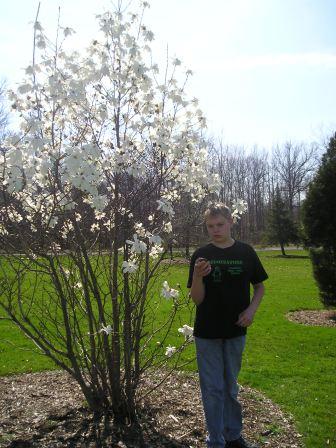
Before reaching our next Waymark we admired this small Japanese Umbrella Pine (Sciadopitys verticillata)

and John told us about the sick Lombardy poplar to the left of our next Waymark…

N 42’ 52.227` W077’ 14.669` Weeping Norway Spruce (Picea abies ‘Pendula’)


N 42’ 52.215` W 077’ 14.671` Not
a tree…but to be sure you’re Waymark is accurate: Struggle rock sculpture by Robert Fladd 1985

N 42’ 52.259` W 077’
14.685` We didn’t actually
locate this Waymark…but it was marked in June when it looked like this:
probably a Blue Ash - Fraxinus quadrangulata or perhaps Tree of Heaven -
Ailanthus?

From here we passed the new labyrinth and headed into the
woods/marsh area to the south of the arboretum. Heading to our next Waymark John shared a wealth of
information regarding the poplar / aspen / cottonwood tree as we passed several
of them. Peggy noted that they root out
by runners and we found evidence of that here.


N 42’ 52.181` W 077’ 14.181` Corkscrew
willow (Salix matsudana) Many of us remembered this tree from our 2009 outing with Bruce Gilman.


N 42’ 52.122` W 077’ 14.731` This
Waymark brings you to a spot on the trail to notice a nearby oak tree with a split trunk and one of many Shagbark Hickory trees in
the woods.

N 42’ 52.081` W 077’ 14.739` This
Waymark brings you to the north end of the boardwalk. We were curious to know what was growing where there is usually
water.

N 42’ 52.067` W 077’ 14.751` Once
at this Waymark look up to find a birdhouse in a large Oak tree.


N 42’ 52.063` W 077’ 14.697` Twin White Oak (look up beyond the maple leaves). This is a photo from June when we had help from twins to record our Waymarks.

From here we backtracked and headed north along the wide
wood-chipped trail to the next Waymark.
Jeffery posed for this photo between an Ash and an Oak tree – allowing a
nice comparison for the bark differences Bill was learning about from John.

We also learned about the Lindera benzoin (Spicebush)appreciating the wealth of knowledge John had to share.

There are several other tree species in the woods just south of the arboretum including black walnuts.

John was a true horticulture professor armed with his very own Michael Dirr encyclopedia of trees.


There are several other tree species in the woods just south of the arboretum including black walnuts.

John was a true horticulture professor armed with his very own Michael Dirr encyclopedia of trees.

N 42’ 52.148` W 077’ 14.626` This
Waymark brings you to the bridge adjacent to Marvin Sands Drive.
John asked about the paper Bark Maple that Bruce told us
about back in 2009. We were pleased to
find it still located where it was…but much closer now to the newly
structured roadway.
N 42’ 52.097` W 077’ 14.610` Paper
Bark Maple (Acer griseum) with cinnamon colored bark


Our plan is to continue Waymarking several more trees in the
Arboretum. If you’re interested in
obtaining updated lists – or you have Waymarked coordinates to add to our current
list, please let us know at CanandaiguaBotanical@gmail.com. GPS units can be borrowed from Wood Library in Canandaigua.
*some
species still to be Waymarked at the FLCC Arboretum: Little Leaf Linden
/ Basswood, White Mulberry, Norway Maple, Red Maple, London Planetree,
Sugar Maple, Pin Oak, Black Oak, Coranga Hedge, Native White Cedar,
Thuja, Red Beech, Purple Beech, Hackberry tree, Tulip tree, Ginko,
Scarlet Pimpernel, Colorodo Blue Spruce, European Larch tree.
Find the FLCC Arboretum listed at Waymarking.com:
http://www.waymarking.com/waymarks/WMF2QK_Finger_Lakes_Community_College_Arboretum
Subscribe to:
Posts (Atom)