On Saturday, September 17, 2011 we gathered to walk the Ontario Pathways trail from County Rt 4 near the C.R. Zornow barn to the wooden water tower on Waddell Road in Orleans, NY.
Those attending included:
Fay & David Connelly, Arlene Copeland, John & Ruth Hyde, Peggy Kane, Leona Lauster, Laura Ouimette, Betsy Russell, Nan Seyfried, Pat Weaver, Tim Wilbur.
Ontario Pathways began in 1994 when what was most recently the Penn Central Railroad was turned into trails. The trail is now open without detours from Canandaigua east to Stanley and then north to Orleans. Tim Wilbur (who did some critter hole filling during our walk) invites anyone to join the crew of folks on Wednesday mornings to meet up to clear the trails. You can check out designated crew days at ontariopathways.org or call 585-234-7722 to get on the Wednesday morning Email list to know where the crew will be each Wednesday.
Tim Wilbur with his unique walking stick: Nan being introduced by Betsy:


Betsy Russell who was responsible for beginning the Ontario Pathways Trail in 1994 introduced Nan Seyfried who studied and taught at Delaware State University before making the Finger Lakes her home.
Nan explained how handy the Newcomb's Wildflower Guide is for identifying wildflowers by identifying the flower type, plant type, and leaf type of a species. By taking the numbers assigned to each of these flower/plant/leaf types you check to see what pages that combination appears in the Newcomb's Wildflower Guide to identify the species. Peggy Kane gave it a go and found it easier with practice.

 Nan told us that there are 40 species of asters and 70 species of goldenrod. She did not claim to be an expert of either but seemed to know quite a few on our walk along the Ontario Pathways trail.
New England aster, unknown goldenrod, and white asters:


 Canada Goldenrod (evident by the gall on the stem). The chickadees love this white grub of a little wasp.


Ragweed - the pollen culprit:
Smart weed: tearthumb princess smartweed:

Mayweed (stinking): very pungent smelling species from the chrysanthemum family. 
Yellow tansy, bitter buttons: brought from Europe as a medicinal plant -
abortions in cows, tea herb for female cramping, ant repellant.

Bouncing Bet: soapwart - soap suds from stem of plant used in museums to clean delicate lace
Saint John's Wart: The leaves have resin dots which allow light to shine through. Good for depression.
Sumac: good for lemonade. Vitamin C from Sumac helped Native Americans through the winters. Great winter food for birds. Nan had us try the sumac by setting the hairs on our tongues.


Jewel weed, Touch Me Not: from the impatient family. The blossoms hang like jewels (garnets). The leaves repel water and look as though covered in diamonds when submersed in water. Peggy Kane recalled a time when Maya Hobday described the silver looking wet leaves as fairy wings to small children. When mature pods are touched seeds dispersal happens with a pop. Remove the brown seed covering to reveal a blue turquoise. The roots of the jewel weed are ruby red. 

Teasel: Purple flowers that bloom in rows. used for felling wool and felt.
Crown Vetch (from the bean family):
Butter and Eggs (snapdragon family):
Leona listens for birds and Tim looks for critter holes:

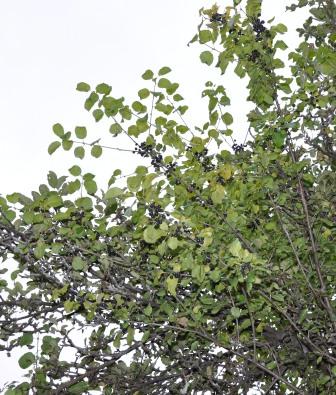
Nan points out the invasive buckthorn and berries:

John Hyde pointed out this Viburnum Opulus. Red berries,wild raisins, wild cranberry

Osier dogwood. red stems - leaves have latex strings
 Gray dogwood with white berries and red stems; blue berries on dagwood

Raspberry leaves have white undersides while blackberry leaves are green with spines:

Physalis (ground cherries) (Andy Fellenz grows these for CSA distributions)

Hawthorn apple:

Thimble weed in seed (anemone)
Tussic moth caterpillar, furry moth caterpillar, and fox berries.
Fuzzy caterpillars turn into moths. Smooth caterpillars turn into butterflies.
wide bands of colors on caterpillars and hearty fox berries...are these signs of a long winter?


Oxalis and Yellow globe Biden stick tight

Bracken fern and milkweed (favorite food and egg laying site for monarchs)


Climbing buckwheat. Triangular seeds, tiny white flowers


Horsetails: Great to use for scouring pots and pans
White Campion catchfly, sticky spots on stems
Bed straw and honeysuckle

Virgins bower and false solomon's-seal
Black Locust? Used for fence posts and perhaps natural arrows (or was that the viburnum?)